Pufferfinance Liquid Restaking, Based Rollups And Ethereum Infrastructure
Pufferfinance develops Ethereum infrastructure for liquid restaking, rollup execution and validator-backed transaction commitments. pufETH represents staked ETH with exposure to additional restaking services. UniFi supplies a based rollup, where Ethereum validators coordinate transaction ordering. Puffer Preconf issues early execution commitments, while institutional solutions address configurable staking operations.
A pufETH position concerns staking exposure; a UniFi application concerns transaction execution. Validator operation and institutional vaults add distinct responsibilities. pufETH redemption depends on liquidity, preconfirmations precede final settlement and institutional vault operations follow configured permissions.
pufETH exposes holders to staking and restaking economics, while UniFi and Puffer Preconf address transaction execution and early commitments.
pufETH, UniFi, Puffer Preconf and Institutional Vaults
The PufferVault receives staking deposits and issues pufETH, the token representing a position in the protocol. Node operators supply Ethereum validation, while restaking operators perform duties for additional services. UniFi provides the execution network, with Puffer Preconf contributing commitments a rollup can expose before Ethereum settlement. Institutional staking adds dedicated vaults and permission controls around validator operations, while custody integrations address how organizations hold and access assets. These roles complement each other, although participating in one product does not automatically place assets in every other product.
Restaked Security and Service Allocation
EigenLayer connects Ethereum validator capital to actively validated services, known as AVSs. Puffer's native restaking modules group validators through EigenPods, the contracts linking their stakes to EigenLayer. Node operators handle Ethereum consensus duties, while restaking operators handle the chosen services under the module's configuration.
Restaking expands the duties supported by staked ETH and introduces penalties associated with those services. Service selection therefore affects a position's exposure. Puffer Preconf's EigenLayer integration connects these products at the infrastructure level; each module's service allocation determines what its staked ETH actually supports.
Does Holding pufETH Require Running a Validator?
Holding pufETH does not require operating an Ethereum validator. The token provides exposure to the protocol's staking and restaking economics without assigning validator duties to its holder.
pufETH is non-rebasing, so accrued rewards affect the ETH represented by each token while the holder's token count stays unchanged. The redemption value can rise when accrued rewards exceed penalties. Operator collateral absorbs validator losses before they reach holders, although losses beyond that buffer and AVS penalties can affect vault backing.
The staking interface supports ETH, WETH, stETH and wstETH inputs. WETH wraps native ETH, while stETH and wstETH represent liquid staking assets. Asset conversion and the vault exchange rate determine the pufETH amount minted. Equal-looking token quantities therefore need not represent equal deposits or produce an equal pufETH amount.
Token spending authorization precedes the staking transaction where the selected input requires it. The interface uses permits for stETH and wstETH and requires an approval transaction for WETH. Native ETH does not require a token permit. Authorization permits spending; the staking transaction performs the deposit and minting.
Validator Participation and Ticket Economics
Puffer's non-enclave registration path requires 2 ETH of collateral and validator tickets to access a validator funded with 32 ETH. The collateral is held as pufETH, and each ticket represents one validator-day of expected staking rewards. Operators retain their validator's actual consensus and execution rewards. Execution rewards reach the configured fee-recipient address. The documented consensus reward route pays pufETH through a claim on Base after successful Beacon Chain withdrawals, accounting and a mandatory waiting period. Smart-contract registrants must set a Base rewards claimer. Ticket revenue contributes to the vault backing pufETH. Module restaking can also pay commissions to operators. Operating profitability reflects rewards earned against ticket costs and validator performance.
UniFi Execution and Cross-Layer Composability
UniFi is an Ethereum Layer 2 execution network built around based sequencing. UniFi derives its transaction sequencing from Ethereum validators. Gateways perform specialized transaction processing on behalf of participating proposers. This arrangement connects rollup ordering to Ethereum while supporting early execution commitments. UniFi's product design also includes native yield integration.
Cross-Layer Coordination
Synchronous composability allows coordinated Ethereum and rollup operations within the same slot in UniFi's supported architecture. Directional messaging mechanisms connect those operations. Their purpose is to let applications interact with Ethereum state and liquidity without treating the rollup as an entirely isolated execution environment.
Signals From Ethereum
Signal Service supports same-slot messaging from Ethereum to UniFi through a signal registry and contract-based verification. Imported signals become available to rollup transactions in the corresponding batch, while the Ethereum-side inbox verifies their registration.
Proofs Returning To Ethereum
UniFi's reverse direction combines OP Stack messaging with proofs from a trusted execution environment, or TEE. These proofs provide attested execution evidence for the supported withdrawal path. This direction has its own proof requirements, separate from importing Ethereum signals.
Withdrawal Routes and Their Different Constraints
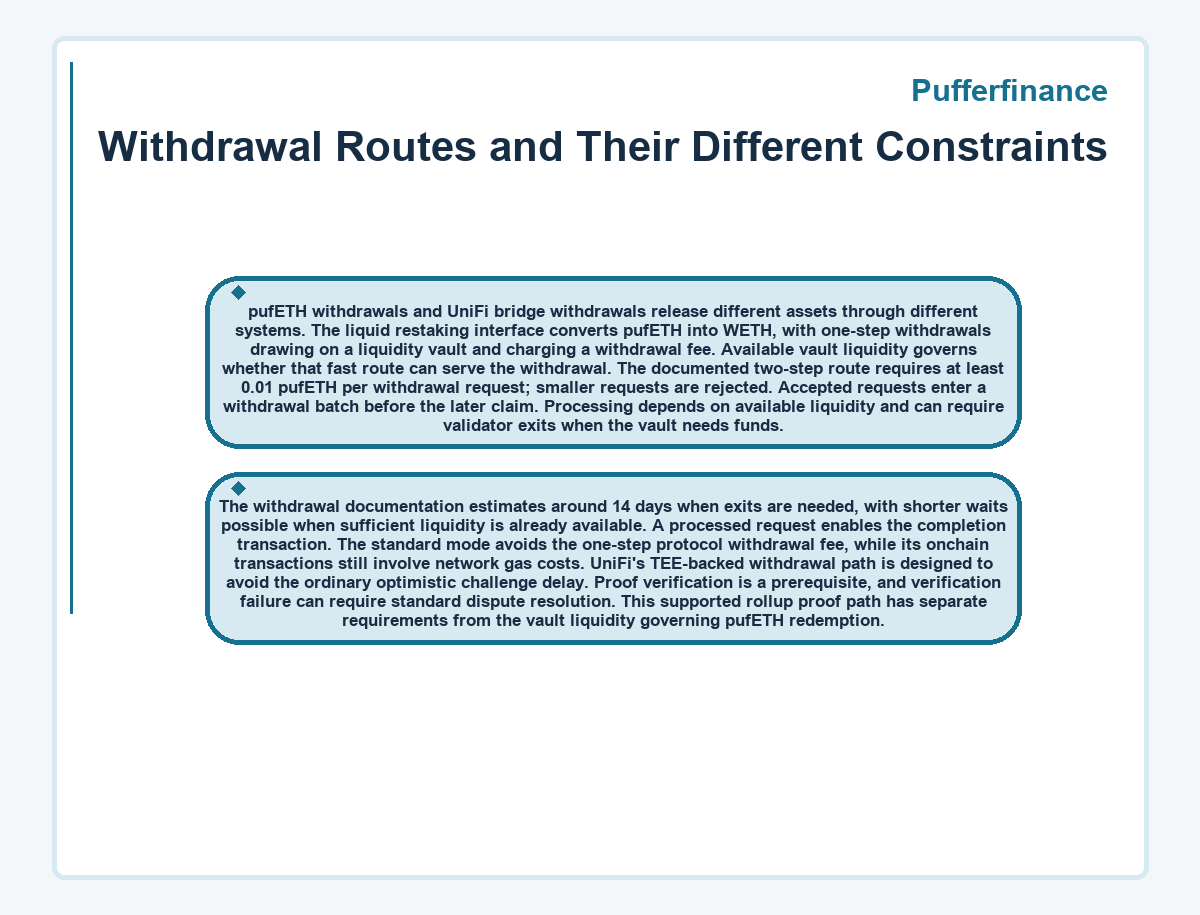
pufETH withdrawals and UniFi bridge withdrawals release different assets through different systems. The liquid restaking interface converts pufETH into WETH, with one-step withdrawals drawing on a liquidity vault and charging a withdrawal fee. Available vault liquidity governs whether that fast route can serve the withdrawal. The documented two-step route requires at least 0.01 pufETH per withdrawal request; smaller requests are rejected. Accepted requests enter a withdrawal batch before the later claim. Processing depends on available liquidity and can require validator exits when the vault needs funds. The withdrawal documentation estimates around 14 days when exits are needed, with shorter waits possible when sufficient liquidity is already available. A processed request enables the completion transaction. The standard mode avoids the one-step protocol withdrawal fee, while its onchain transactions still involve network gas costs.
UniFi's TEE-backed withdrawal path is designed to avoid the ordinary optimistic challenge delay. Proof verification is a prerequisite, and verification failure can require standard dispute resolution. This supported rollup proof path has separate requirements from the vault liquidity governing pufETH redemption.
Does a Preconfirmation Mean a Transaction Is Final?
A UniFi preconfirmation precedes block sealing and does not establish final settlement. The commitment describes an expected execution state, while the block and its later settlement have distinct completion requirements. Preconfirmed state can revert to the sealed view if the unsealed block is discarded.
Execution commitments concern a transaction's promised state and outcome, while inclusion commitments concern whether it enters a block. This difference matters when an application needs an execution result before Ethereum settlement. An early commitment does not establish a completed withdrawal or Ethereum finality.
Puffer Preconf's Phase 1 uses reward forfeiture for missed proposals and supports OP Stack rollups through the Gattaca gateway. Full slashing and user refunds belong to the Phase 3 design. A Phase 1 integration therefore does not provide the later phase's refund and slashing mechanisms merely because it issues preconfirmations.
Institutional Vaults and Custody Arrangements
Puffer Institutional supports dedicated staking and restaking vaults with configurable operational permissions. The vault handles validator deployment, restaking and reward distribution. Traditional staking and restaking can coexist within the structure, with separate accounting for their assets and rewards. Institutions receive vault share tokens representing their deposits.
The AccessManager contract controls permissions for vault operations. Ownership can use a multisignature wallet or an externally owned account, depending on the configuration. Selecting restaking exposure and defining permission holders remain separate decisions.
Anchorage Digital's pufETH integration lets its clients mint or acquire the token within its platform. Custody workflows and internal controls remain with the custody provider, while Puffer supplies the underlying yield infrastructure. This access route differs from managing a dedicated institutional vault.
The September 29, 2026 partnership announcement selected Anchorage Digital as UniFi's day-one institutional custodian. Announced collaboration also covers stablecoin infrastructure, native settlement and agentic payments. UniFi supplies the execution and settlement environment; Anchorage supplies institutional custody and related infrastructure. These launch commitments have a different scope from the existing pufETH access arrangement.
Participation Options and Operating Conditions
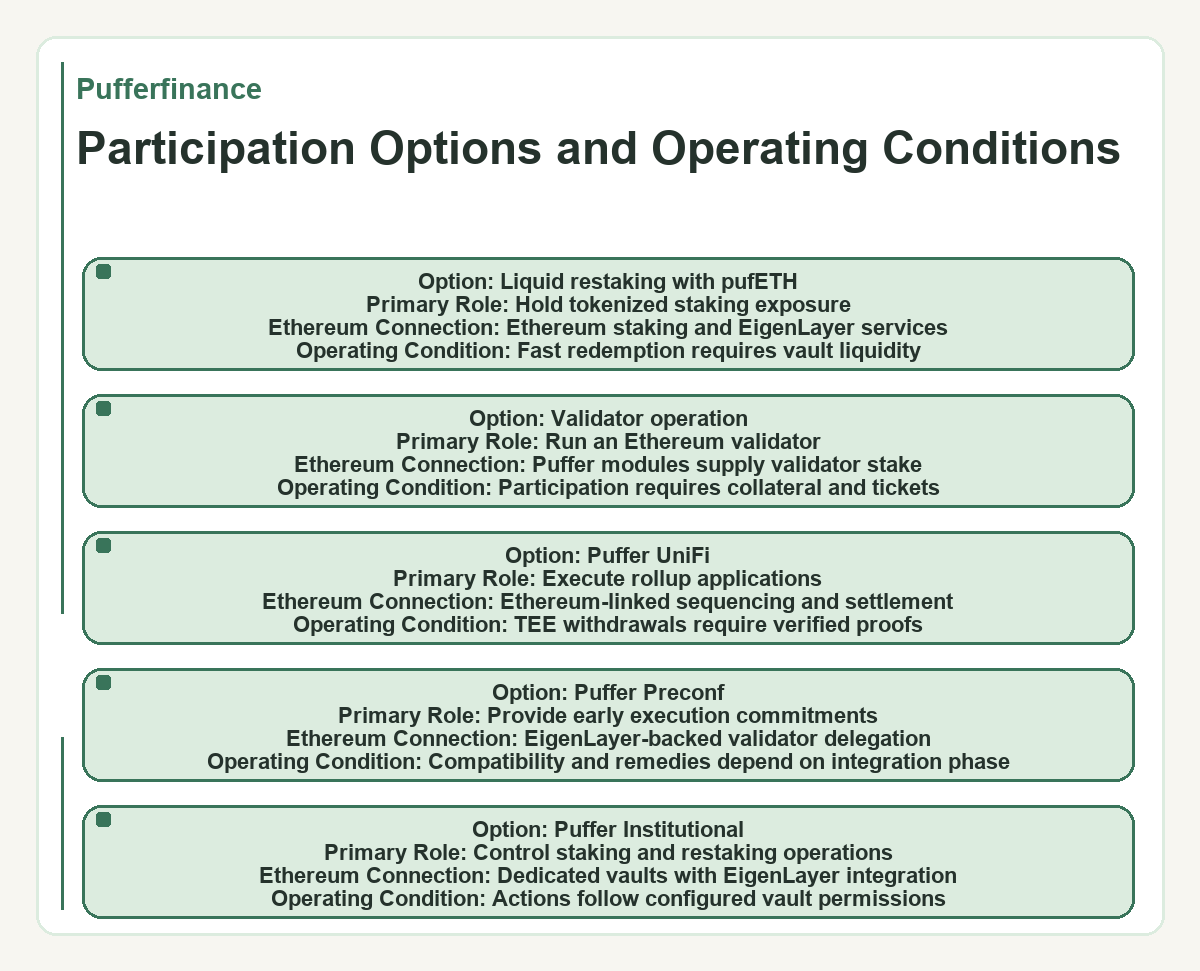
| Option | Primary Role | Ethereum Connection | Operating Condition |
|---|---|---|---|
| Liquid restaking with pufETH | Hold tokenized staking exposure | Ethereum staking and EigenLayer services | Fast redemption requires vault liquidity |
| Validator operation | Run an Ethereum validator | Puffer modules supply validator stake | Participation requires collateral and tickets |
| Puffer UniFi | Execute rollup applications | Ethereum-linked sequencing and settlement | TEE withdrawals require verified proofs |
| Puffer Preconf | Provide early execution commitments | EigenLayer-backed validator delegation | Compatibility and remedies depend on integration phase |
| Puffer Institutional | Control staking and restaking operations | Dedicated vaults with EigenLayer integration | Actions follow configured vault permissions |
Participation Options and Operating Conditions
- Option: Liquid restaking with pufETH Primary Role: Hold tokenized staking exposure Ethereum Connection: Ethereum staking and EigenLayer services Operating Condition: Fast redemption requires vault liquidity
- Option: Validator operation Primary Role: Run an Ethereum validator Ethereum Connection: Puffer modules supply validator stake Operating Condition: Participation requires collateral and tickets
- Option: Puffer UniFi Primary Role: Execute rollup applications Ethereum Connection: Ethereum-linked sequencing and settlement Operating Condition: TEE withdrawals require verified proofs
- Option: Puffer Preconf Primary Role: Provide early execution commitments Ethereum Connection: EigenLayer-backed validator delegation Operating Condition: Compatibility and remedies depend on integration phase
- Option: Puffer Institutional Primary Role: Control staking and restaking operations Ethereum Connection: Dedicated vaults with EigenLayer integration Operating Condition: Actions follow configured vault permissions
Staking Exposure Versus Application Execution
A staking position without AVS participation avoids the additional duties and penalties of those services. Native restaking adds that exposure alongside Ethereum staking. pufETH packages the position into a transferable token, while validator operation involves running infrastructure and meeting its operational requirements. An institutional vault emphasizes permission control over its own staking arrangement.
A rollup with a dedicated sequencer concentrates transaction ordering in that operator. UniFi coordinates ordering with Ethereum proposers and delegated gateways, while its cross-layer architecture connects applications to Ethereum liquidity. Staking exposure concerns underlying rewards and redemption, while rollup execution concerns application behavior and settlement. Ordinary staking addresses the former task without supplying the latter network.

Details worth knowing about Pufferfinance
Is PUFFER the Same Asset as pufETH?
PUFFER and pufETH are separate assets with different roles. PUFFER is the governance token for the Puffer protocol and UniFi ecosystem. pufETH represents a liquid restaking position. Governance locking can produce vlPUFFER, a non-transferable voting-power token. Those governance rights do not replace the staking position represented by pufETH, and acquiring PUFFER does not mint a pufETH deposit receipt.
Do Rollups Need PUFFER Tokens to Integrate Puffer Preconf?
Puffer Preconf participation does not require holding the Puffer governance token. That policy covers validators, gateways and Layer 2 rollups. Operators and validators follow the service's enrollment requirements, while rollups need compatible gateway integration. The absence of a token requirement does not remove technical compatibility conditions or expand a deployment phase's supported rollup architectures.
Which Ethereum Development Tools Work With UniFi?
UniFi supports familiar Ethereum development tools, including Foundry and Hardhat. It is mostly equivalent to the Ethereum Virtual Machine, so familiar deployment tools do not establish identical contract behavior. Differences include address aliasing for certain contract-initiated messages from Ethereum and rollup-specific block fields. Contracts relying on those behaviors need to account for UniFi's execution rules.
Why Can UniFi Event Queries Lag Behind a Transaction Receipt?
UniFi event queries use sealed blocks, while receipts can expose preconfirmed transactions. Logs can already appear on the receipt before event queries return them. That gap lasts until the relevant block seals. The rule applies to eth_getLogs, filter queries and log subscriptions. An empty event query during the preconfirmation window does not establish that the receipted transaction emitted no events.
Where Does UniFi Testnet Settle Its Transactions?
UniFi Testnet settles to Ethereum's Hoodi testnet. UniFi Testnet uses chain ID 2092151908, while Hoodi uses chain ID 560048. These identifiers distinguish the development networks from Ethereum mainnet. The ETH currency symbol shown in the UniFi Testnet configuration belongs to that test network. It does not turn a testnet balance into a mainnet ETH position.
Updated on